I got pretty fed up with looking for words to replace said because they weren’t sorted in a way I could easily use/find them for the right time. So I did some myself.
I’M DRUNK OR JUST BEING WEIRDLY EXPRESSIVE FOR A POINT/SARCASM Hooted Howled Yowled
I WONDER Pondered Voiced Wondered
OH, YEAH, WHOOPS Recalled Recited Remembered
SURPRISE BITCH Revealed
IT SEEMS FAKE BUT OKAY/HA ACTUALLY FUNNY BUT I DON’T WANT TO LAUGH OUT LOUD Scoffed Snickered Snorted
BITCHY Tattled Taunted Teased
Edit: People, I’m an English and creative writing double major in college; I understand that there’s nothing wrong with simply using “said.” This was just for fun, and it comes in handy when I need to add pizzazz.
I can’t BELIEVE I haven’t plugged this yet, because it’s so legit.
@jstor just sealed itself in my heart as the coolest resource ever by combining my two greatest loves – Digital Humanities and Shakespeare – to create an AMAZING site called Understanding Shakespeare.
It works like this (hold on to your seats, this is so cool):
Say you reach a line in a Shakespeare play where there’s a reference or symbol you don’t understand and/or would like to know more about. Usually, it would take a substantial amount of time to figure out the meaning, find the key theme, search through research databases, and maybe hit something that references your line.
But no longer!
Because with Understanding Shakespeare, you can go to the line and look at all the scholarship published on JSTOR that features or references to it! Oh my god!!!
An example:
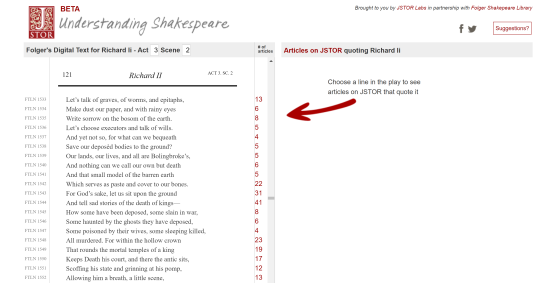
So I really love Richard II’s “graves, worms, and epitaphs” speech, it’s one of my very favorites, and I’d love to learn more about it and the symbols of death and historical references contained within it. So I go to the line in Richard II:
Click on the first line and voila! There’s a ton of articles that quote this line, and several of them look really interesting and relevant!
So whether you’re looking for more information on a line for research or performance understanding, or you just like being sucked down the addictive rabbit hole of reading JSTOR articles all afternoon (me), Understanding Shakespeare is AWESOME and a resource you should totally take advantage of.
Who owns businesses? Families? Shareholders? The government?
Are there service industries (hairdressing, tech support,
etc.)?
Where do people learn a trade? From their parents? As an apprentice?
From a private trade school? From a government-run trade school?
Who in a family is expected to work?
Who in a family is allowed to work?
If everyone is allowed and expected to work, who watches
children? Are there nannies? Daycares? If it’s done by older children, what
happens when there’s only one child?
Who takes care of the elderly? The daughter’s family? The
son’s family? A nursing home? What if they have no children?
Are there child labor laws?
Are there laws regarding work hours, safety, etc.?
Are unions legal?
Are there government regulations on businesses, industries,
etc.?
Are there government-provided services?
Are there social safety nets?
Are there banks? If not, where/how do people store money?
Is there a mortgage or loan system?
Is it expected that a person or family will own a house?
Is there government-run housing?
Is there support for the homeless?
Is there support for the disabled?
Is there an equivalent to the stock market?
Is there standardized currency? Who manufactures it?
Is there a fixed exchange rate (eg the gold standard) or are
currencies free-floating?

 Penhales